

סטודנטים וסטודנטיות יקרים,

Dear students,
We are commencing the 2025–2026 academic year with great hope, following the return of the hostages and the end of the Iron Swords war. We continue to think of the fallen hostages who are still in Gaza. We call for the return of every single one, and hope that these events will inspire a belief in the reinstatement of calm – and perhaps even peace – in our region. They also inspire hope for the successful rebuilding and healing of Israeli society and of the region as a whole, as well as for peaceful coexistence.
The past two years have been extremely challenging, to say the least. The war, bloodshed, destruction and devastation have had serious psychological and physical consequences, which we will continue to cope with. At the beginning of the last academic year, I wrote to you that the arts play a unique role in times of war. I believe that this is no less true in the aftermath of such a difficult period. The arts provide us with tools for coping with a new reality: they allow us to hear the voices of individuals, to tell the story of war, killing, and destruction, and thus to process these difficult events. They support the rehabilitation of physical and social structures, and strengthen our ability to support personal resilience. Indeed, the arts can both inspire and promote hope.
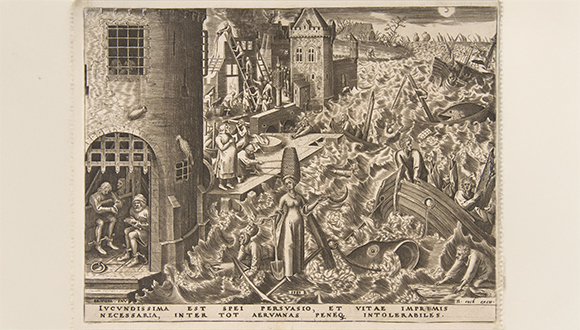
Pieter Bruegel the Elder, Hope (Spes), 1559–1560
In 1559–1560, the Flemish painter Pieter Bruegel the Elder created a series of engravings depicting the seven virtues: Prudence (Wisdom), Justice, Fortitude (Courage), Temperance, Faith, Charity (Love), and Hope. These seven virtues, drawn from Greek mythology and Christian theology, represented the set of qualities and values that formed the basis of proper moral conduct according to the worldview of 16th-century Europeans.
In the arts, the virtues were often depicted as allegorical female figures – as evidenced in this engraving by Bruegel, who chose to represent the personification of hope, Spes, as a woman. Spes stands at the center of a stormy scene saturated with human suffering – sinking ships, beggars, prisoners, and people struggling to survive or reaching out toward the light. In the midst of this chaos, she appears calm yet determined. On her head she wears a beehive – a symbol of community life, cooperation, and shared labor. The anchor in her right hand symbolizes hope as an anchor for the soul, while the work tools in her left hand allude to agricultural labor, renewal, and growth.
Through these images, Bruegel presents hope as a tangible earthly quality – not a heavenly force that elevates humans above their suffering, but rather an inner force that exists within the world. For Bruegel, hope stems from community life, physical and mental labor, and the possibility of renewal – simple yet profound actions through which humans can regain a sense of peace and even overcome despair.
Just over a century later in Amsterdam, not far from Bruegel’s Antwerp, the Jewish philosopher Baruch Spinoza expanded on the question of hope by similarly turning to Spes. In the third part of his book Ethics (1677), Spinoza presents hope as the opposite of despair, defining it as a structure that is always directed toward the future. Hope, according to his method, is an orientation forward to the possible, to the good that has not yet materialized. However, Spinoza viewed hope as always mixed with fear – fear of the threatening present, or of the possibility that the desired future will never come.
For Spinoza, the figure of Spes embodied the aspiration for hope that does not succumb to fear, but rather stands up to it with courage and strength. From a moral stance, Spinoza warns us not to lose hope, and certainly not to replace it with fear – for hope, even when fragile, is an expression of the power of life and a cornerstone on the path to a better future.
As we begin the 2025–2026 academic year, I wish you a year of hope without fear.
Remember – it is our moral duty to embody hope, and to promote a better future through the arts.
Good luck with your studies,

Eran